Skip to content
Adaptive

Learn Newton's Laws

Read the notes, then try the practice. It adapts as you go.When you're ready.

Session Length

~17 min

Adaptive Checks

15 questions

Transfer Probes

8

Lesson Notes

Newton's three laws of motion form the foundation of classical mechanics and explain how objects behave when forces act on them. The first law (law of inertia) states that an object remains at rest or moves at constant velocity unless a net external force acts upon it. The second law quantifies this relationship with the equation F = ma, linking net force, mass, and acceleration. The third law establishes that every action force has an equal and opposite reaction force acting on a different object.

Building correct intuitions about these laws requires confronting several persistent misconceptions. Many students believe that motion requires a continuous force, that heavier objects fall faster, or that action-reaction pairs cancel each other out. Working through carefully designed problems, especially free-body diagrams and multi-object systems, helps replace these naive ideas with accurate physical reasoning.

Newton's laws connect directly to nearly every other topic in mechanics, including friction, projectile motion, circular motion, and momentum conservation. Mastering these laws provides the analytical toolkit needed to solve problems ranging from elevator physics and Atwood machines to vehicle collisions and orbital mechanics.

You'll be able to:

  • State and distinguish Newton's three laws of motion and identify which law applies in a given physical scenario
  • Draw accurate free-body diagrams and use them to calculate net force, acceleration, and individual force magnitudes
  • Solve quantitative problems involving F = ma for single objects, inclined planes, and connected multi-object systems
  • Identify and correct common misconceptions such as force-implies-motion, heavier-falls-faster, and action-reaction cancellation
  • Apply Newton's laws to real-world contexts including elevator physics, vehicle collisions, and Atwood machines

One step at a time.

Free-body force diagram
Visualizing forces in actionPexels

Interactive Exploration

Adjust the controls and watch the concepts respond in real time.

Key Concepts

Inertia (First Law)

An object at rest stays at rest, and an object in motion stays in motion at constant velocity, unless acted upon by a net external force.

Example: A hockey puck sliding on ice continues moving in a straight line until friction or a stick changes its motion.

Net Force and Acceleration (Second Law)

The acceleration of an object is directly proportional to the net force acting on it and inversely proportional to its mass, expressed as F = ma.

Force vectors illustrating F = ma

Example: Pushing an empty shopping cart accelerates it more than pushing a full one with the same force, because the full cart has greater mass.

Action-Reaction Pairs (Third Law)

For every action force, there is an equal and opposite reaction force. These forces act on different objects simultaneously.

Example: When you push against a wall, the wall pushes back on your hands with an equal force in the opposite direction.

Net Force

The vector sum of all forces acting on an object. When net force is zero, the object is in equilibrium and does not accelerate.

Example: A book resting on a table has gravity pulling it down and the normal force pushing it up; these cancel out so the net force is zero.

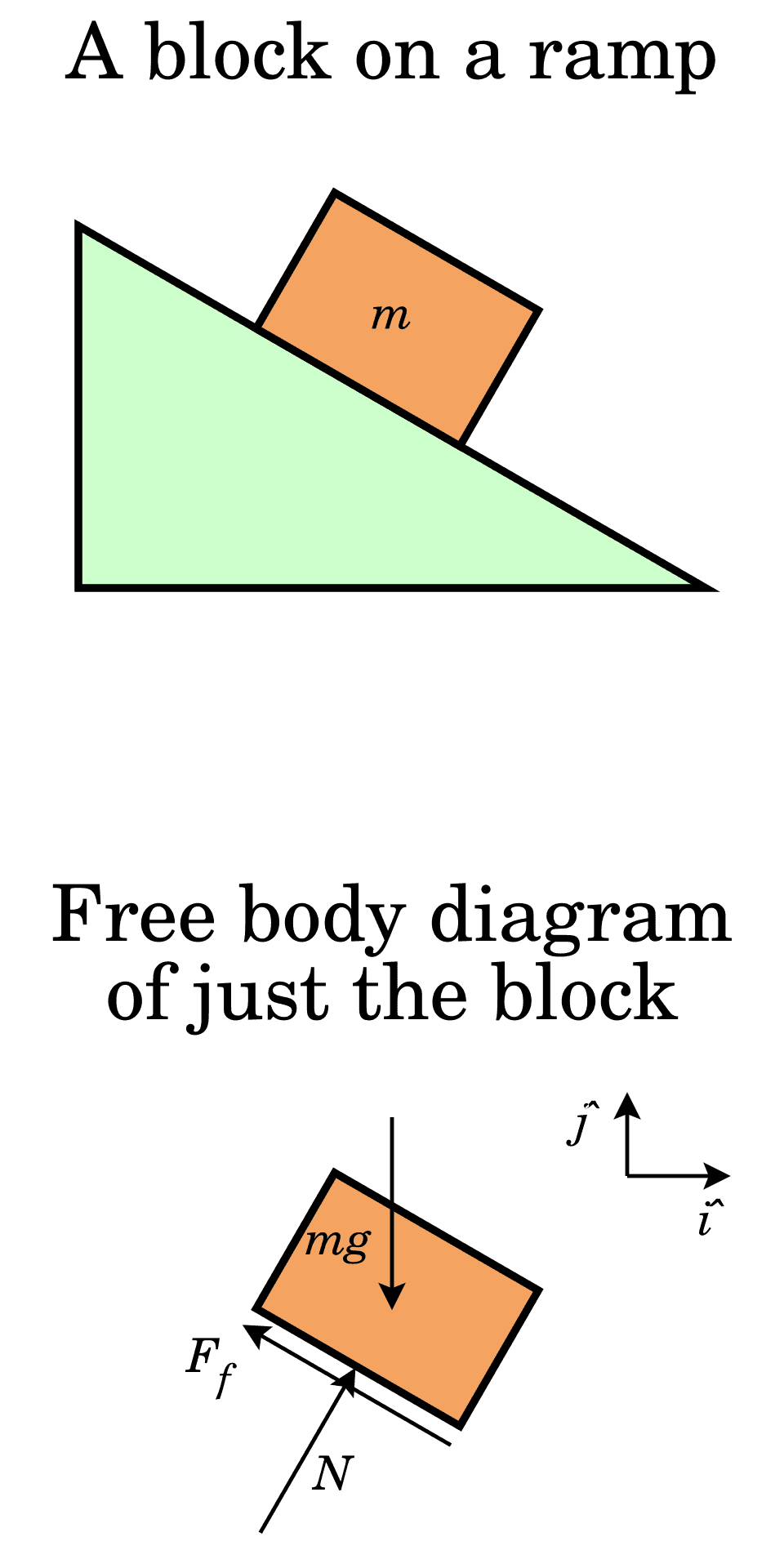
Free-Body Diagram

A simplified drawing that shows all the forces acting on a single object as arrows pointing in the direction each force is applied.

Free-body diagram showing all forces on an object

Example: Drawing a box on a ramp with arrows for gravity, normal force, and friction helps you determine the net force along and perpendicular to the surface.

Mass versus Weight

Mass is the intrinsic quantity of matter in an object (measured in kg) and does not change with location. Weight is the gravitational force on that mass (W = mg) and varies with the local gravitational field strength.

Example: An astronaut has the same mass on the Moon as on Earth, but weighs about one-sixth as much because the Moon's gravitational acceleration is roughly 1.6 m/s^2 instead of 9.8 m/s^2.

Equilibrium

A state in which the net force on an object is zero. Static equilibrium means the object is at rest; dynamic equilibrium means it moves at constant velocity.

Example: A book on a table is in static equilibrium (net force zero), while a car cruising at constant speed on a straight highway is in dynamic equilibrium.

Normal Force

The perpendicular contact force exerted by a surface on an object. It adjusts in magnitude to prevent objects from passing through surfaces and plays a key role in friction calculations.

Example: When you stand on the floor, the floor pushes up on you with a normal force equal to your weight. On an incline, the normal force equals mg cos(theta) rather than the full weight.

Explore your way

Choose a different way to engage with this topic β€” no grading, just richer thinking.

Explore your way β€” choose one:

Explore with AI β†’

Concept Map

See how the key ideas connect. Nodes color in as you practice.

Worked Example

Walk through a solved problem step-by-step. Try predicting each step before revealing it.

Adaptive Practice

This is guided practice, not just a quiz. Hints and pacing adjust in real time.

Small steps add up.

What you get while practicing:

  • Math Lens cues for what to look for and what to ignore.
  • Progressive hints (direction, rule, then apply).
  • Targeted feedback when a common misconception appears.

Teach It Back

The best way to know if you understand something: explain it in your own words.

Keep Practicing

More ways to strengthen what you just learned.

Newton's Laws Adaptive Course - Learn with AI Support | PiqCue