
Newton's Laws
IntermediateNewton's three laws of motion form the foundation of classical mechanics and explain how objects behave when forces act on them. The first law (law of inertia) states that an object remains at rest or moves at constant velocity unless a net external force acts upon it. The second law quantifies this relationship with the equation F = ma, linking net force, mass, and acceleration. The third law establishes that every action force has an equal and opposite reaction force acting on a different object.
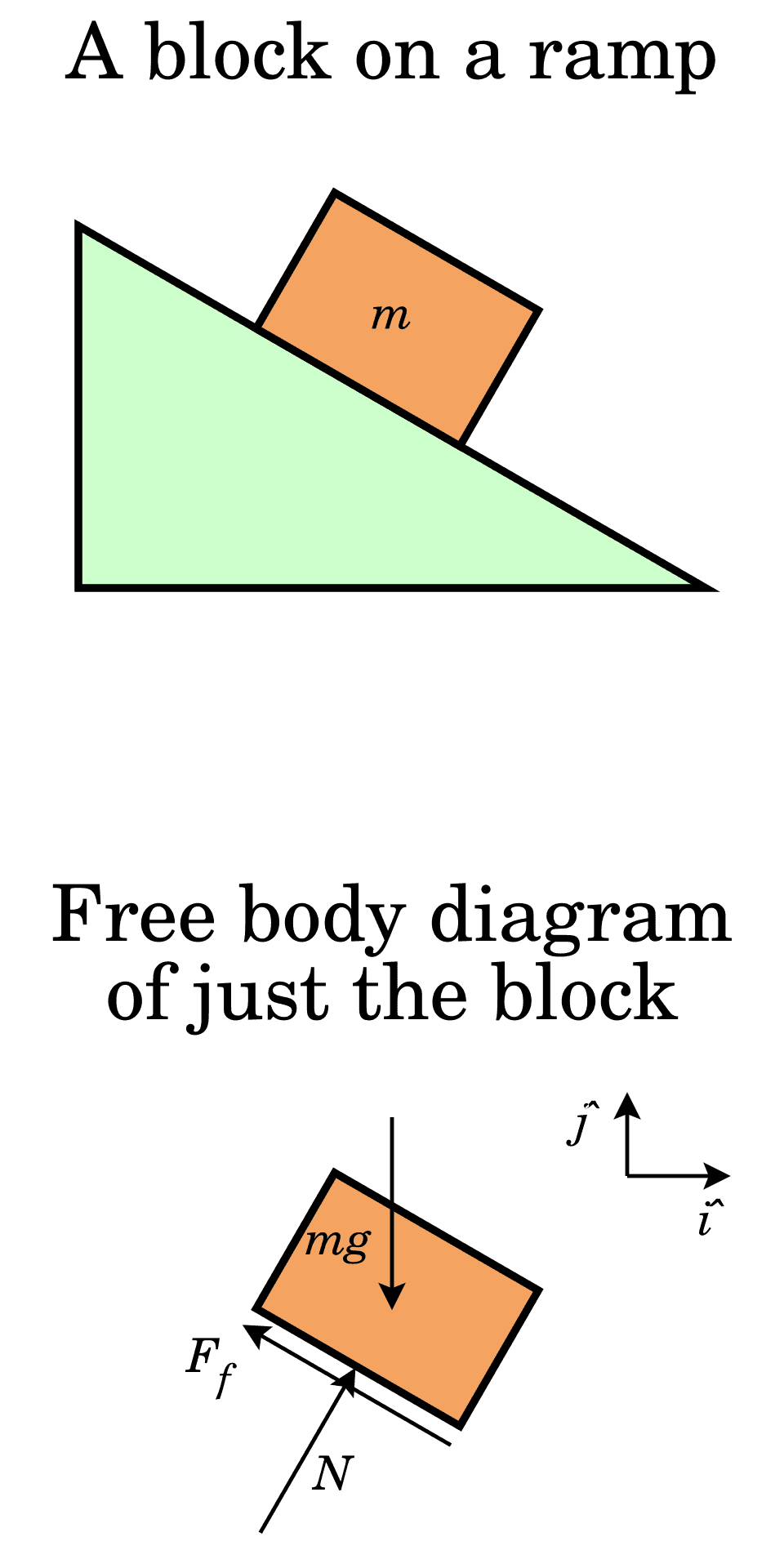
Building correct intuitions about these laws requires confronting several persistent misconceptions. Many students believe that motion requires a continuous force, that heavier objects fall faster, or that action-reaction pairs cancel each other out. Working through carefully designed problems, especially free-body diagrams and multi-object systems, helps replace these naive ideas with accurate physical reasoning.
Newton's laws connect directly to nearly every other topic in mechanics, including friction, projectile motion, circular motion, and momentum conservation. Mastering these laws provides the analytical toolkit needed to solve problems ranging from elevator physics and Atwood machines to vehicle collisions and orbital mechanics.
Practice a little. See where you stand.
Quiz
Reveal what you know — and what needs work
Adaptive Learn
Responds to how you reason, with real-time hints
Flashcards
Build recall through spaced, active review
Cheat Sheet
The essentials at a glance — exam-ready
Glossary
Master the vocabulary that unlocks understanding
Learning Roadmap
A structured path from foundations to mastery
Book
Deep-dive guide with worked examples
Argument
Map claim and supporting evidence
Key Concepts
One concept at a time.
Explore your way
Choose a different way to engage with this topic — no grading, just richer thinking.
Explore your way — choose one:
Curriculum alignment— Standards-aligned
Grade level
Learning objectives
- •State and distinguish Newton's three laws of motion and identify which law applies in a given physical scenario
- •Draw accurate free-body diagrams and use them to calculate net force, acceleration, and individual force magnitudes
- •Solve quantitative problems involving F = ma for single objects, inclined planes, and connected multi-object systems
- •Identify and correct common misconceptions such as force-implies-motion, heavier-falls-faster, and action-reaction cancellation
- •Apply Newton's laws to real-world contexts including elevator physics, vehicle collisions, and Atwood machines
Related Topics
Friction & Forces
Understand how static and kinetic friction arise from surface contact, depend on the normal force, and connect to Newton's laws in real-world problems.
Projectile Motion
Projectile motion analyzes objects launched into the air by decomposing their movement into independent horizontal and vertical components governed by constant velocity and gravitational acceleration, respectively.
Conservation of Momentum
Conservation of momentum states that the total momentum of a closed system remains constant through any interaction, enabling analysis of collisions, explosions, and recoil using vector addition of mass-velocity products.
Physics
Physics is the study of matter, energy, and the fundamental forces of nature, encompassing everything from the motion of everyday objects to the behavior of subatomic particles and the structure of the cosmos.