Skip to content
Adaptive

Learn Energy, Work, and Power — Work energy theorem, Power (extended)

Read the notes, then try the practice. It adapts as you go.When you're ready.

Session Length

~11 min

Adaptive Checks

10 questions

Transfer Probes

5

Lesson Notes

Energy, work, and power form a tightly connected triad at the heart of mechanics. Work is defined as the transfer of energy when a force causes a displacement: = F d cos heta$, where $ heta$ is the angle between the force and displacement vectors. Only the component of force along the displacement does work, which is why carrying a box horizontally at constant height involves zero work against gravity even though effort is required to hold it up.

Kinetic energy ( = frac{1}{2}mv^2$) quantifies the energy of motion, while gravitational potential energy ( = mgh$) captures stored energy due to position in a gravitational field. The work-energy theorem states that the net work done on an object equals its change in kinetic energy: {net} = Delta KE$. When only conservative forces act, total mechanical energy is conserved, enabling powerful shortcuts: instead of tracking forces and accelerations, we equate energy at two points. Non-conservative forces like friction convert mechanical energy into thermal energy, reducing the total mechanical energy of the system.

Power measures the rate of energy transfer: = frac{W}{t} = Fv$. A machine that does the same work faster operates at higher power. Understanding energy concepts is essential for analyzing everything from roller coasters and pendulums to collisions and spring systems, and lays the groundwork for thermodynamics and modern physics.

You'll be able to:

  • Calculate work done by constant and variable forces and apply the work-energy theorem
  • Apply conservation of mechanical energy to systems with and without non-conservative forces
  • Distinguish between kinetic, gravitational potential, and elastic potential energy and convert between them
  • Define and calculate power as the rate of energy transfer using both P = W/t and P = Fv

One step at a time.

Key Concepts

Work

The transfer of energy when a force acts on an object through a displacement. Calculated as = Fdcos heta$, where $ is the force magnitude, $ is the displacement, and $ heta$ is the angle between them. Work is measured in joules (J).

Example: Pulling a sled 10 m with a rope at 30 degrees above horizontal with 50 N of tension does = 50(10)cos 30^circ = 433$ J of work.

Kinetic Energy

The energy an object possesses due to its motion, given by = frac{1}{2}mv^2$. Since velocity is squared, doubling speed quadruples kinetic energy. Kinetic energy is always positive and is a scalar quantity.

Example: A 1200 kg car traveling at 20 m/s has = frac{1}{2}(1200)(20)^2 = 240{,}000$ J of kinetic energy.

Gravitational Potential Energy

Energy stored due to an objects position in a gravitational field, calculated as = mgh$ near Earths surface, where $ is the height above a chosen reference level. The choice of reference level is arbitrary because only changes in PE matter physically.

Example: A 5 kg book on a 2 m high shelf has = 5(9.8)(2) = 98$ J of gravitational potential energy relative to the floor.

Conservation of Mechanical Energy

In a system with only conservative forces (gravity, springs), the total mechanical energy = KE + PE$ remains constant. Energy transforms between kinetic and potential forms but the sum never changes.

Example: A pendulum at its highest point has maximum PE and zero KE; at the lowest point all PE has converted to KE, and total energy is the same at both positions.

Work-Energy Theorem

The net work done on an object equals the change in its kinetic energy: {net} = Delta KE = frac{1}{2}mv_f^2 - frac{1}{2}mv_i^2$. This theorem connects the force-displacement perspective with the energy perspective of motion.

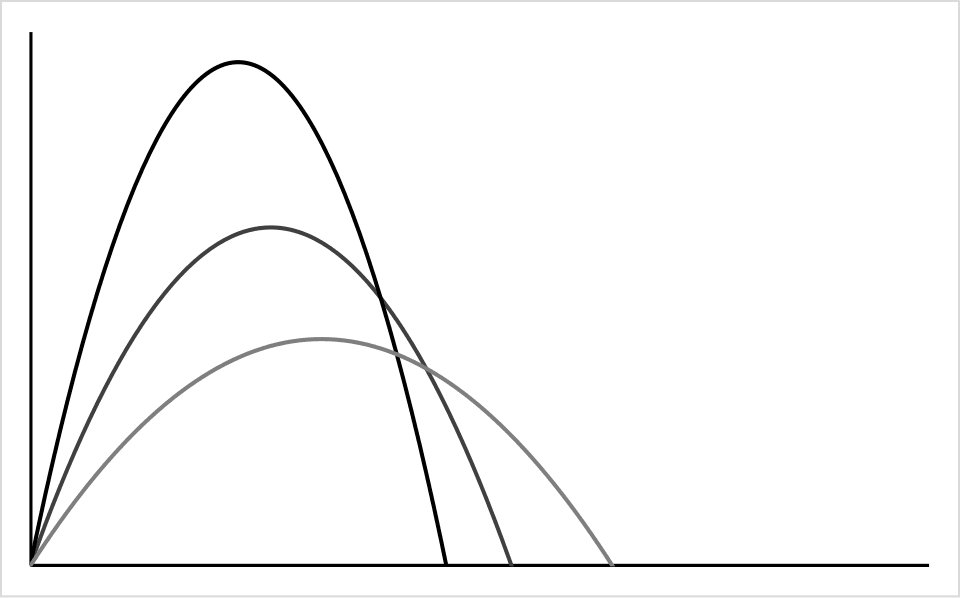
Object in motion showing energy transformations

Example: A 2 kg block accelerated from rest to 6 m/s requires net work of = frac{1}{2}(2)(6)^2 - 0 = 36$ J.

Power

The rate at which work is done or energy is transferred: = frac{W}{t}$. For an object moving at constant velocity under a force, = Fv$. Power is measured in watts (W), where 1 W = 1 J/s.

Example: An elevator motor lifting a 1000 kg load at 2 m/s must supply = (1000)(9.8)(2) = 19{,}600$ W of power.

Elastic Potential Energy

Energy stored in a compressed or stretched spring, given by = frac{1}{2}kx^2$, where $ is the spring constant and $ is the displacement from equilibrium. This energy can be fully recovered as kinetic energy when the spring returns to its natural length.

Example: A spring with = 200$ N/m compressed by 0.3 m stores = frac{1}{2}(200)(0.3)^2 = 9$ J of elastic potential energy.

Non-Conservative Forces and Dissipation

Forces like friction and air resistance that convert mechanical energy into thermal energy. When non-conservative forces act, total mechanical energy decreases: $Delta E_{mech} = W_{nc}$, where {nc}$ is negative work done by dissipative forces.

Example: A box sliding to a stop on a rough surface converts all its kinetic energy to thermal energy via friction: $ frac{1}{2}mv^2 = mu_k mg d$.

Explore your way

Choose a different way to engage with this topic — no grading, just richer thinking.

Explore your way — choose one:

Explore with AI →

Concept Map

See how the key ideas connect. Nodes color in as you practice.

Worked Example

Walk through a solved problem step-by-step. Try predicting each step before revealing it.

Adaptive Practice

This is guided practice, not just a quiz. Hints and pacing adjust in real time.

Small steps add up.

What you get while practicing:

  • Math Lens cues for what to look for and what to ignore.
  • Progressive hints (direction, rule, then apply).
  • Targeted feedback when a common misconception appears.

Teach It Back

The best way to know if you understand something: explain it in your own words.

Keep Practicing

More ways to strengthen what you just learned.

Energy, Work, and Power — Work energy theorem, Power (extended) Adaptive Course - Learn with AI Support | PiqCue