Skip to content
Adaptive

Learn Electric Circuits

Read the notes, then try the practice. It adapts as you go.When you're ready.

Session Length

~17 min

Adaptive Checks

15 questions

Transfer Probes

8

Lesson Notes

Electric circuits are the backbone of modern technology, governing the flow of electric charge through interconnected components to perform useful work. At the AP Physics 2 level, circuit analysis centers on the relationships between current, voltage, and resistance as described by Ohm's law ($V = IR$), the rules governing series and parallel combinations of resistors and capacitors, and the energy and power considerations that determine how circuits convert electrical energy into heat, light, motion, and other forms. Understanding circuits requires connecting the macroscopic quantities measured by instruments (ammeter readings, voltmeter readings) to the microscopic picture of charge carriers drifting through conductors under the influence of electric fields.

Kirchhoff's laws provide the systematic framework for analyzing complex circuits. Kirchhoff's junction rule (conservation of charge) states that the total current entering any junction equals the total current leaving it. Kirchhoff's loop rule (conservation of energy) states that the sum of all voltage gains and drops around any closed loop in a circuit is zero. Together, these laws allow students to set up and solve systems of equations for circuits that cannot be reduced to simple series-parallel combinations. These principles extend naturally to circuits containing capacitors, where charge storage and the time-dependent behavior of RC circuits introduce the concept of exponential charging and discharging.

Capacitors store energy in the electric field between their plates, with capacitance $C = Q/V$ quantifying the charge-to-voltage ratio. In RC circuits, the time constant $\tau = RC$ governs how quickly capacitors charge and discharge, producing exponential current and voltage curves that are fundamental to timing circuits, filters, and signal processing. Power dissipation in resistive circuits follows $P = IV = I^2R = V^2/R$, connecting circuit analysis to energy transfer and thermal effects. Mastery of circuit concepts is essential for understanding the electrical systems that underpin everything from household wiring to the microprocessors in computers.

You'll be able to:

  • Apply Ohm's law to calculate current, voltage, and resistance in simple circuits
  • Determine equivalent resistance for series and parallel resistor combinations
  • Use Kirchhoff's junction and loop rules to analyze complex multi-loop circuits
  • Calculate capacitance, charge, and energy stored in capacitors
  • Analyze the time-dependent behavior of RC circuits using exponential functions

One step at a time.

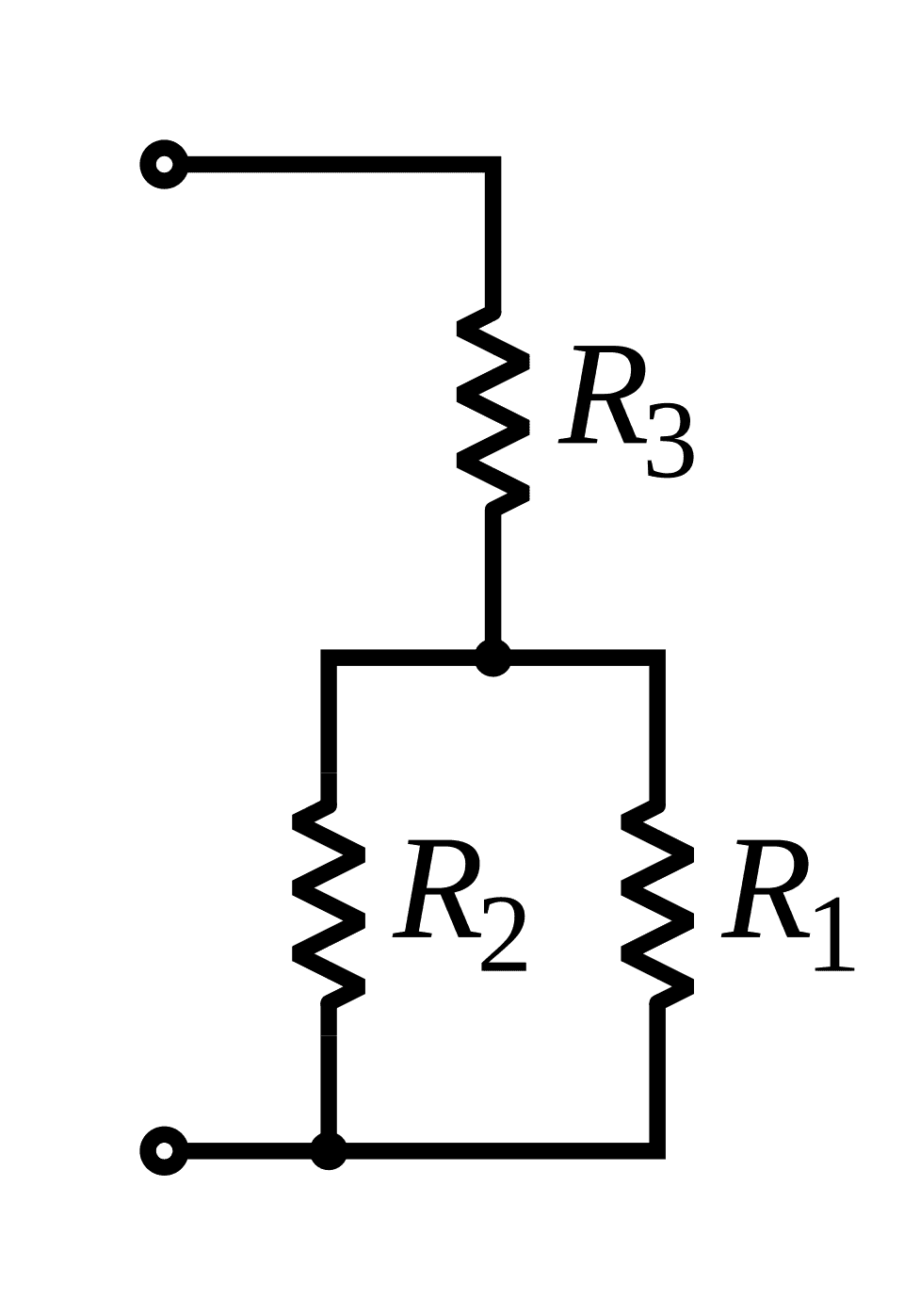
Electric circuit schematic
The flow of electric currentPexels

Interactive Exploration

Adjust the controls and watch the concepts respond in real time.

Key Concepts

Electric Current

The rate of flow of electric charge through a cross-section of a conductor: $I = \Delta Q / \Delta t$. Conventional current flows from high to low potential (positive terminal to negative terminal), while electrons actually drift in the opposite direction. The SI unit is the ampere (1 A = 1 C/s).

Circuit diagram showing current flow through components

Example: A wire carrying 2 A of current delivers 2 coulombs of charge per second past any cross-section. In a copper wire, this corresponds to billions of electrons drifting slowly (millimeters per second) through the conductor.

Voltage (Potential Difference)

The work done per unit charge in moving charge between two points in a circuit: $V = W/q$. A battery or power supply provides an electromotive force (EMF) that maintains a potential difference, driving current through the circuit. Measured in volts (1 V = 1 J/C).

Example: A 9 V battery does 9 joules of work for every coulomb of charge it pushes through the circuit from its negative to its positive terminal (inside the battery).

Resistance and Ohm's Law

Resistance is the opposition to current flow in a conductor: $R = V/I$ (Ohm's law). It depends on the material's resistivity $\rho$, length $L$, and cross-sectional area $A$: $R = \rho L / A$. The SI unit is the ohm ($\Omega$). Ohmic materials have constant resistance; non-ohmic materials (like diodes) do not.

Example: A 100 $\Omega$ resistor with 10 V across it carries a current of $I = V/R = 10/100 = 0.1$ A (100 mA).

Series Circuits

Components connected end-to-end so the same current flows through each one. In a series connection, the total resistance is the sum: $R_{\text{total}} = R_1 + R_2 + \cdots$. The voltage divides among components proportionally to their resistances.

Series circuit with resistors in a single loop

Example: Three resistors of 2 $\Omega$, 3 $\Omega$, and 5 $\Omega$ in series have a total resistance of 10 $\Omega$. With a 20 V battery, the current is $I = 20/10 = 2$ A through all three.

Parallel Circuits

Components connected across the same two nodes so each has the same voltage across it. The reciprocal of total resistance is the sum of reciprocals: $1/R_{\text{total}} = 1/R_1 + 1/R_2 + \cdots$. The total current divides among branches inversely proportional to their resistances.

Parallel circuit with branching current paths

Example: Two 6 $\Omega$ resistors in parallel have an equivalent resistance of $1/(1/6 + 1/6) = 3\ \Omega$, half of each individual resistance.

Kirchhoff's Junction Rule

At any junction (node) in a circuit, the total current entering equals the total current leaving: $\sum I_{\text{in}} = \sum I_{\text{out}}$. This is a statement of conservation of electric charge -- charge does not accumulate at junctions in steady-state circuits.

Example: If 5 A enters a junction and splits into two branches, and one branch carries 3 A, the other must carry 2 A.

Kirchhoff's Loop Rule

The sum of all voltage changes (gains and drops) around any closed loop in a circuit is zero: $\sum \Delta V = 0$. This is a statement of conservation of energy -- a charge that traverses a complete loop returns to its starting potential.

Example: In a loop with a 12 V battery and two resistors dropping 5 V and 7 V respectively: $+12 - 5 - 7 = 0$, confirming the loop rule.

Capacitance

The ability of a device to store charge per unit voltage: $C = Q/V$. For a parallel-plate capacitor, $C = \epsilon_0 A / d$, where $A$ is plate area and $d$ is plate separation. Energy stored: $U = \frac{1}{2}CV^2$. The SI unit is the farad (F).

Example: A 10 $\mu$F capacitor charged to 100 V stores $Q = CV = 10^{-5} \times 100 = 10^{-3}$ C (1 mC) of charge and $U = \frac{1}{2}(10^{-5})(100)^2 = 0.05$ J of energy.

More terms are available in the glossary.

Explore your way

Choose a different way to engage with this topic โ€” no grading, just richer thinking.

Explore your way โ€” choose one:

Explore with AI โ†’

Concept Map

See how the key ideas connect. Nodes color in as you practice.

Worked Example

Walk through a solved problem step-by-step. Try predicting each step before revealing it.

Adaptive Practice

This is guided practice, not just a quiz. Hints and pacing adjust in real time.

Small steps add up.

What you get while practicing:

  • Math Lens cues for what to look for and what to ignore.
  • Progressive hints (direction, rule, then apply).
  • Targeted feedback when a common misconception appears.

Teach It Back

The best way to know if you understand something: explain it in your own words.

Keep Practicing

More ways to strengthen what you just learned.

Electric Circuits Adaptive Course - Learn with AI Support | PiqCue