
Skip to content
Adaptive

Learn AP Precalculus

Read the notes, then try the practice. It adapts as you go.When you're ready.

Session Length

~17 min

Adaptive Checks

15 questions

Transfer Probes

8

Lesson Notes

AP Precalculus gets you ready for calculus by focusing on how functions work—and why.

You'll learn to shift, stretch, and flip graphs. You'll connect algebra to real growth (populations, money) and decay. You'll see how sine and cosine model things that repeat, like waves and seasons.

The big idea: understand what's happening, not just memorize steps. When you change what goes in vs what comes out, the graph moves in different ways. That distinction matters everywhere.

You'll be able to:

  • Shift, stretch, and flip graphs using the inside/outside rule
  • Compose functions and find their domains
  • Use functions to model growth, decay, and repeating patterns
  • Read end behavior, asymptotes, and zeros from equations and graphs
  • Solve exponential and log equations

One step at a time.

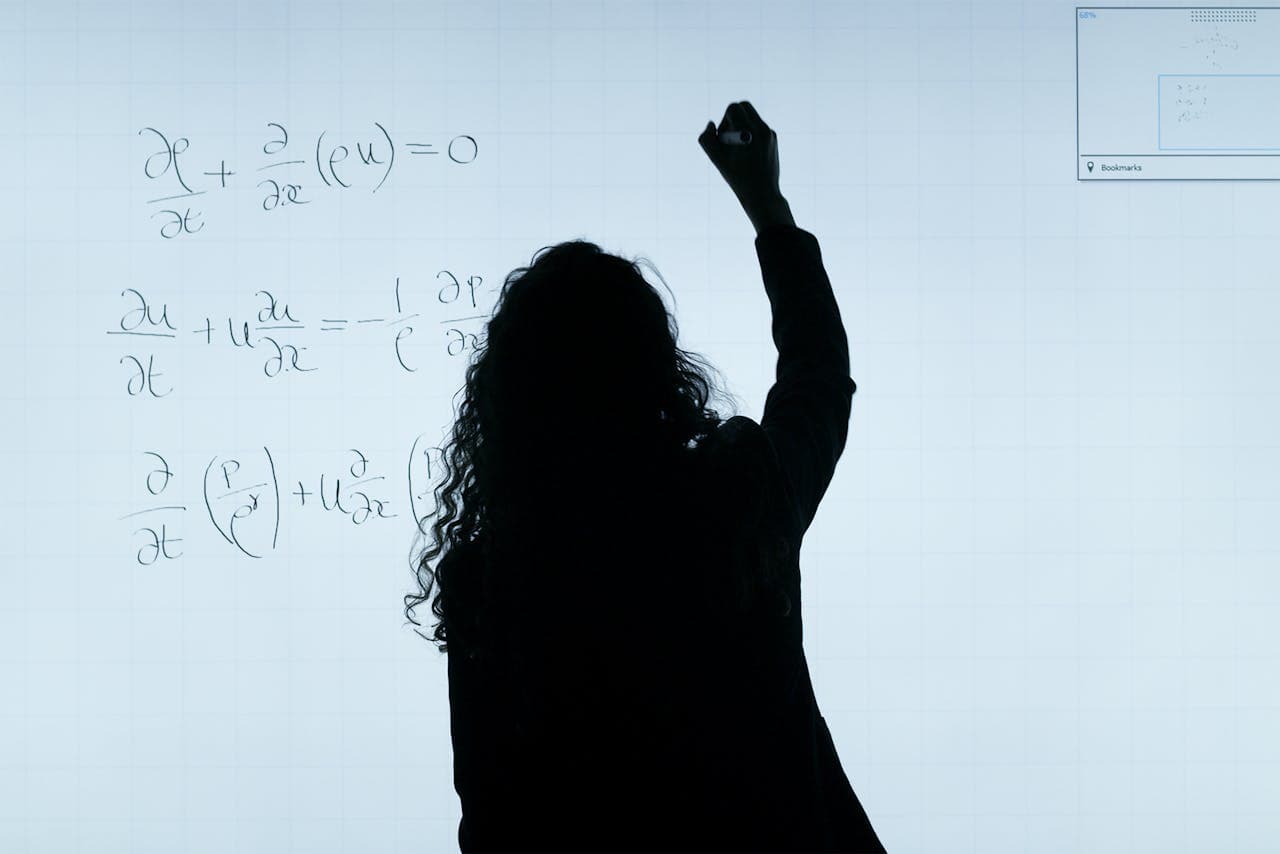
Mathematical equations and graphs on a whiteboard
Precalculus builds the foundation for calculusPexels

Key Concepts

Function Transformations

Moving, stretching, or flipping a graph. Changes to the input (inside) move left/right. Changes to the output (outside) move up/down. That inside/outside split trips people up—but it's the key.

Example: $g(x)=-2(x+3)^2-1$ starts as $x^2$, then flips, stretches by 2, shifts left 3, and down 1.


Polynomial Functions

Functions built from powers of x. The highest power tells you how the ends behave: odd degree = opposite ends; even degree = same ends.

Graphs of polynomial functions of various degrees

Example: $f(x)=-x^3+4x$ rises left, falls right (odd degree, negative lead). Zeros at -2, 0, 2.

Rational Functions

One polynomial divided by another. Vertical asymptotes happen where the bottom is zero. Holes happen when top and bottom share a factor.

Example: $f(x)=\frac{x^2-1}{x^2-4}$ has asymptotes at $x=\pm 2$ and crosses the x-axis at $\pm 1$.

Exponential Growth and Decay

Multiply by the same factor over equal steps. Growth when the base > 1; decay when it's between 0 and 1. Used for populations, money, radioactivity.

Graph of exponential growth and decay curves

Example: Bacteria doubling every 3 hours: 500 to 1000 to 2000 to 4000. After 9 hours: 4000 cells.

Logarithms

Logs undo exponents. $\log_b(y)=x$ means "to what power do we raise b to get y?" Turns multiplication into addition.

Example: To solve $2^{t/3}=8$: $t/3=\log_2(8)=3$, so $t=9$.

Function Composition

Plug one function into another. Do the inner one first; use that result as the input to the outer one. Order matters.

Example: For $f(g(2))$: find g(2) first, then plug that into f. It's not f(2) times g(2).

Inverse Functions

A function that undoes another. $f^{-1}$ takes the output and gives back the input. Only works for one-to-one functions (each output comes from exactly one input).

Example: If $f(x)=2x+3$ doubles and adds 3, then $f^{-1}(x)=(x-3)/2$ reverses it.

Trig and the Unit Circle

Sine and cosine come from a circle of radius 1. cosine = x-coordinate, sine = y-coordinate. They repeat every $2\pi$—perfect for waves, tides, anything that cycles.

Unit circle showing sine, cosine, and key angle values

Example: At 60 degrees, the circle point is (1/2, sqrt(3)/2). So cos=1/2, sin=sqrt(3)/2.

More terms are available in the glossary.

Explore your way

Choose a different way to engage with this topic — no grading, just richer thinking.

Explore your way — choose one:

Explore with AI →

Concept Map

See how the key ideas connect. Nodes color in as you practice.

Worked Example

Walk through a solved problem step-by-step. Try predicting each step before revealing it.

Printable Practice Worksheets

Use these for paper practice or in-class checkpoints.

  • Unit 3 periodic functions paper practice sheet for graphing and modeling.

Adaptive Practice

This is guided practice, not just a quiz. Hints and pacing adjust in real time.

Small steps add up.

What you get while practicing:

  • Math Lens cues for what to look for and what to ignore.
  • Progressive hints (direction, rule, then apply).
  • Targeted feedback when a common misconception appears.

Teach It Back

The best way to know if you understand something: explain it in your own words.

Keep Practicing

More ways to strengthen what you just learned.

AP Precalculus Adaptive Course - Learn with AI Support | PiqCue